Multi-engine translation API architecture: routing, failover and observability
Build a provider-neutral translation workflow with capability-aware routing, bounded failover, circuit breakers and a practical rollout checklist.

A multi-engine translation service becomes useful when a product needs to change providers without rewriting its callers, or when particular languages, availability requirements and deployment policies need different routes. A second provider adds value only if it can accept the actual workload and produce an acceptable result.
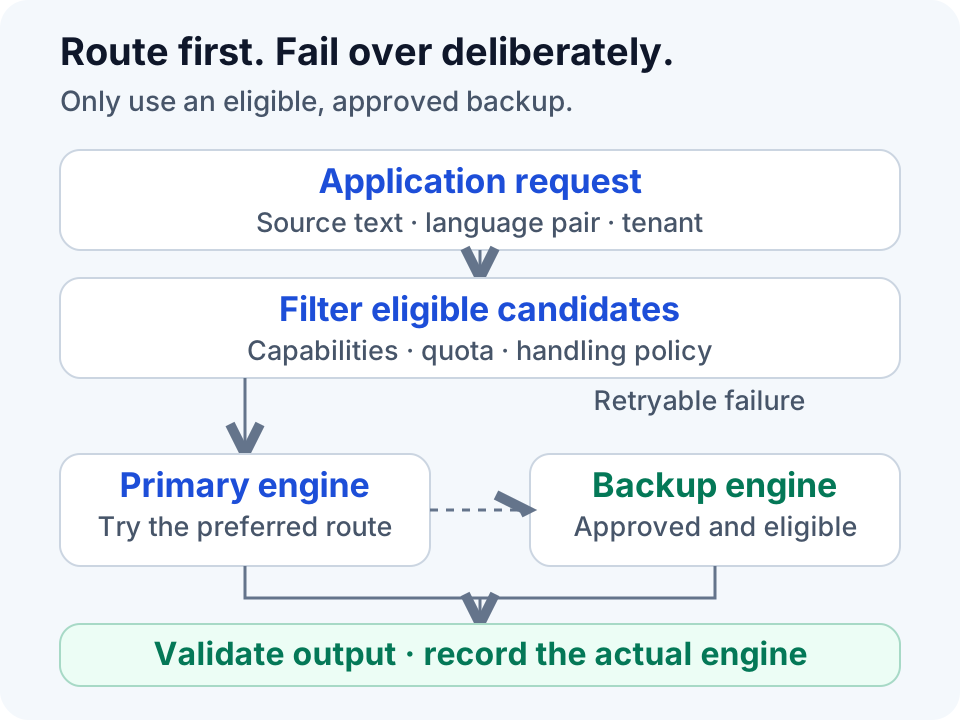
The design starts with a stable internal request, a small provider adapter and an explicit routing policy. Failover, caching and monitoring then operate on those contracts instead of guessing what each provider returned.
This article describes an application architecture. The current engine availability FAQ identifies DeepL as implemented and verified; other adapters are being integrated. Check availability before configuring a backup.
1. Decide whether a second engine solves a real problem
Record the languages, content types, daily character volume and maximum acceptable response time. A help center translated during a build has a different deadline from a support agent waiting for a message. A batch job can usually pause; an interactive request needs a bounded response.
If one provider meets the requirements, keep it behind an adapter and postpone automatic switching. A second integration introduces language mappings, credentials, another billing model and a second quality baseline. It does not remove the need for those controls.
Define three explicit outcomes: use the preferred engine, use an approved alternative, or return a recoverable failure. Returning source text as if it were a translation hides an outage and can publish the wrong language.
2. Separate the application contract from provider payloads
Your internal request should carry the information needed for routing and traceability. The adapter translates it into the provider’s documented payload and normalizes the response.
| Internal field | Why it exists |
|---|---|
requestId | Connect a caller’s request to individual provider attempts |
tenantId | Select credentials, quotas and data boundaries |
text, sourceLang, targetLang | Describe the translation task |
contentType | Distinguish plain text and other supported formats |
policyRevision | Identify the routing and quality rules applied |
allowFallback | Record whether an approved alternative may be used |
These are application-side fields, not instructions to send undocumented parameters to TranslateHub. For the public endpoint and accepted fields, use the API documentation.
Keep each adapter responsible for language-code mapping, authentication, serialization, error classification and cancellation. Its result should include translated text and the actual engine used. Preserve a provider trace identifier when supplied, but do not invent a usage value when the response does not contain one.
3. Filter candidates before choosing an engine
Check language direction, supported format, required terminology features, permitted data region, available quota and operational state. A healthy engine that cannot preserve the required format is not a valid backup.
Separate hard constraints from preferences. Data location and required features are constraints; latency and price can be preferences among the remaining candidates. A low price must not override a tenant’s processing restrictions.
Define what an explicit engine selection means. If a customer selects an engine to reproduce a translation, silently switching changes the experiment. Make fallback permission explicit in your application policy, and keep the candidate order stable for one request.
4. Classify failures instead of retrying everything
An HTTP status is an input to an adapter’s classification, not a universal policy across providers. DeepL’s error-handling guide, for example, distinguishes invalid input, authorization errors, throttling and exhausted quota.
| Example response | Application action |
|---|---|
400, invalid input | Fix the request; do not resend unchanged input |
403, authorization failure | Check credentials and permissions |
413, oversized request | Split according to the endpoint’s limits |
429, throttling | Respect applicable retry instructions and reduce pressure |
456, exhausted quota | Resolve the usage limit instead of retrying the same account |
| Transient server or network failure | Consider a bounded retry or an eligible backup |
A backup cannot fix invalid source data or a broken application credential. Treat a tenant’s exhausted budget separately from an outage: switching must not bypass a budget the tenant intended to enforce. A timeout also does not prove that the remote provider stopped processing or billing the attempt.
5. Give the whole request a deadline
Three individually reasonable timeouts can still produce an unreasonable wait. Establish a total deadline covering attempts, backoff and validation. Start an attempt only if enough time remains.
This JavaScript example shows sequential failover over an already filtered list. Adapters must honor the abort signal and map failures to the internal kind values. Timing values are illustrative settings, not performance measurements.
export async function translateWithFallback(request, eligibleAdapters, { budgetMs = 2400, attemptMs = 1000 } = {}) {
  const deadline = performance.now() + budgetMs;
  const candidates = request.allowFallback ? eligibleAdapters : eligibleAdapters.slice(0, 1);
  let lastError = new Error('No eligible translation engine');

  for (const adapter of candidates) {
    const remaining = Math.floor(deadline - performance.now());
    if (remaining < 100) break;

    try {
      const result = await adapter.translate(request, {
        signal: AbortSignal.timeout(Math.min(attemptMs, remaining)),
      });
      if (typeof result.text !== 'string' || result.text.length === 0) {
        throw new Error('Invalid translation response');
      }
      return { ...result, engine: adapter.id };
    } catch (error) {
      lastError = error;
      const retryable =
        error instanceof Error &&
        (error.name === 'TimeoutError' || ['rate_limited', 'unavailable'].includes(error.kind));
      if (!retryable) throw error;
    }
  }
  throw lastError;
}
Provider cooldowns, a retry queue and caller cancellation belong around this loop. An adapter that ignores cancellation can exceed the deadline, so test against a deliberately slow upstream before deployment. If a provider’s retry delay exceeds the remaining budget, return a retryable job state or use an approved alternative rather than hiding an unbounded wait.
6. Use circuit breakers to stop repeating known failures
A circuit breaker prevents every new request from testing an engine already known to be unavailable. Scope its state to the failure boundary: an engine-wide outage differs from one tenant’s invalid key or exhausted quota.
The closed state allows traffic and counts relevant failures. The open state skips that candidate during a cooldown. Half-open allows a limited number of recovery probes; success can restore normal routing, while another relevant failure reopens the circuit.
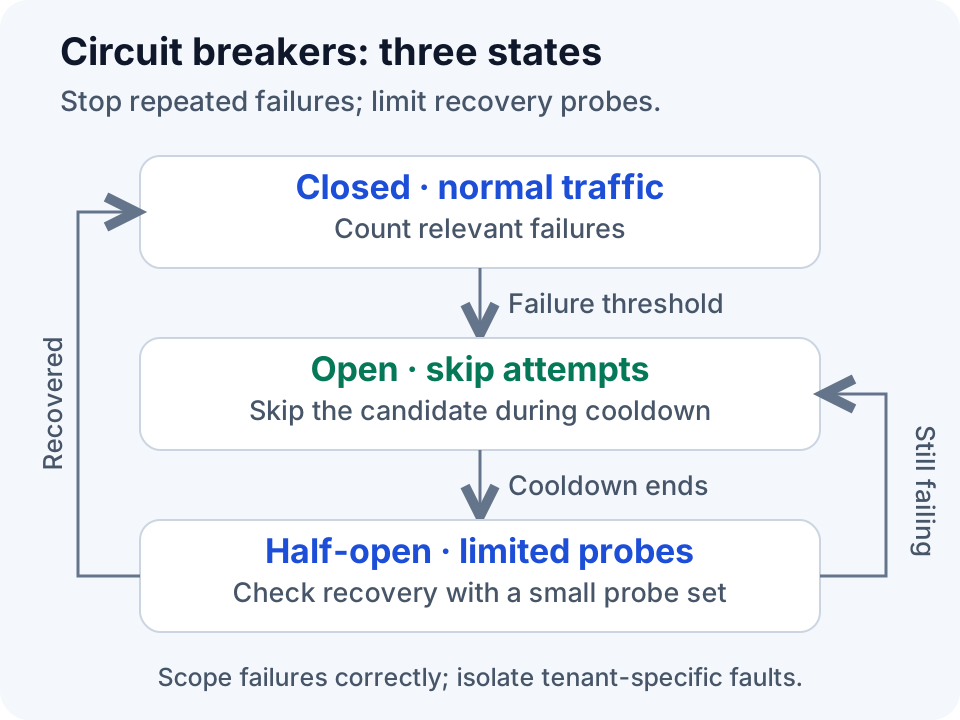
Choose thresholds from observed traffic. At low volume, one failure can distort a percentage; at high volume, a long observation window reacts slowly. Exclude caller mistakes from outage counts and limit simultaneous recovery probes across instances when necessary.
7. Keep quality and cache identity consistent
Engines can produce different terminology, punctuation and formality. For a document requiring consistent wording, pin the engine and terminology revision for the job. If fallback occurs, record affected segments and decide whether they need review.
The cache must distinguish results whose engine or translation policy differs. Otherwise a fallback result may appear to be the preferred engine’s output. The translation caching guide covers identity, invalidation and concurrent misses.
Before enabling a route, evaluate engines against the same representative source set. Include placeholders, numbers, negation and domain terminology. Save the source revision and criteria so later comparisons are reproducible; the quality evaluation framework provides a starting structure.
8. Measure attempts separately from completed requests
Log request ID, engine, attempt number, duration, outcome class and fallback use. Avoid API keys and full customer text in routine logs. Preserve provider-specific trace IDs separately where available.
Measure end-to-end P50/P95 latency, per-engine attempt latency, final failure rate, fallback rate and provider attempts per completed request. Successful fallback can improve availability while increasing latency and character usage; success rate alone does not reveal those costs.
For batch jobs, record submitted characters and actual reported usage separately. A timed-out attempt followed by a successful backup can produce more upstream work than the final saved output suggests. Reconcile estimates with provider usage and the tenant’s budget.
9. Roll out one route at a time
- Put the existing engine behind a tested adapter without changing its route.
- Validate an alternative against required languages, formats and handling policies.
- Test invalid input, missing credentials, throttling, slow responses and complete upstream failure.
- Confirm that disabling fallback prevents backup calls and that slow attempts respect deadlines.
- Start with one workload or a small approved traffic group; monitor quality, usage and latency together.
- Keep a switch that restores the previous route without changing caller code.
A useful drill verifies the final user response, provider call count and recovery behavior. Checking only that a backup was called misses duplicate retries and recovery spikes.
10. Common implementation questions
Should every failure trigger failover?
No. Define permitted failure classes and filter candidates first. Invalid input, a tenant budget limit and authentication failure each need a deliberate response.
Is parallel hedging faster than sequential fallback?
It can reduce some slow-tail responses, but sends the text to multiple providers and can create multiple billable attempts. Use it only when policy and budget permit it, after measuring the benefit.
What should the application return when every engine fails?
Return a recoverable error or a job state that can be retried later. If the interface displays source text, label it as the original rather than a successful translation.