Meeting recording translation: transcripts, speakers and action items
Separate transcription, translation and minutes; preserve speaker labels, timestamps, uncertainty and evidence for bilingual action items.
A tidy translated meeting summary is not proof that a recording was understood correctly. A missing negative, an incorrect speaker label, or a suggestion rewritten as an agreed task can change what the team does next. Smooth formatting can conceal errors introduced before translation even began.
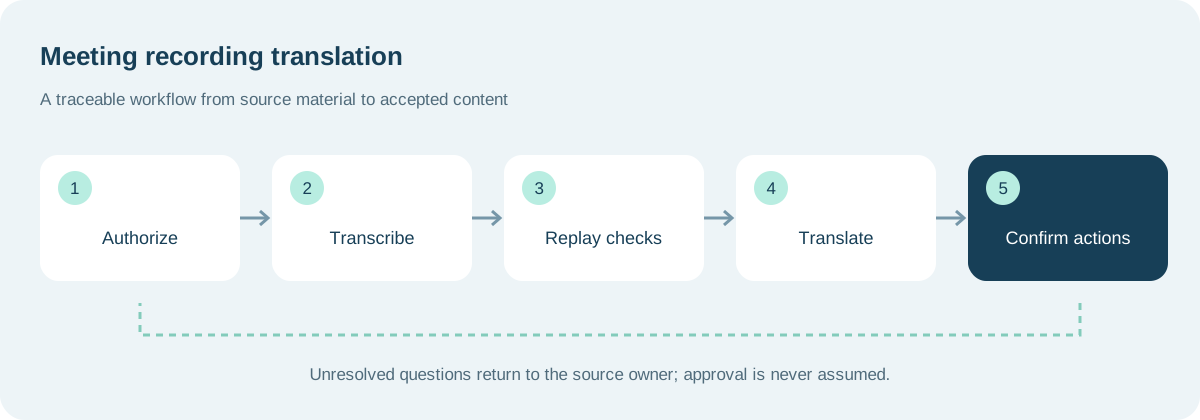
A more reliable workflow preserves four layers: the authorized recording, a reviewable source-language transcript, the corresponding translation, and minutes with explicit decision states. Each layer should lead back to the previous one so reviewers can investigate uncertainty and correct information already shared.
1. Establish purpose and handling boundaries
Confirm recording permission and any required notice under the organization’s process. Requirements can vary by location, organization, and meeting type. A tool’s default recording setting is not universal authorization to capture or process a conversation.
Define the deliverable: verbatim transcript, readable edited transcript, full translation, or action-item summary. These are different products. When precise quotation or auditability matters, preserve the underlying record and editing history instead of treating generate minutes as a substitute for every requirement.
Determine access, retention, and deletion responsibilities. Meetings may contain customer details, unreleased plans, or personal information. Send only the necessary authorized material to approved services rather than copying complete recordings across several unknown platforms for convenience.
2. Improve the input before demanding better output
Use a clear microphone signal and reduce echo and background noise where possible. Separate audio tracks may help when the platform and permission scope allow them, but do not assume that every recording contains an independent channel for each participant.
Check that the file plays completely and includes the opening and closing discussion. Confirm that external calls or shared video audio actually reached the recording. Information that was never captured cannot be recovered merely by writing a stronger translation prompt.
Prepare relevant names, product terms, abbreviations, and agenda vocabulary for transcription and review. Include only necessary, authorized information. A vocabulary list supplies candidates; it does not establish that an unclear sound must be one of the listed terms.
3. Separate transcription from translation
The first stage establishes what was said in the source language. The second expresses that content in another language. Review negatives, quantities, units, names, and important conditions in the transcript before translation. Otherwise, the system may translate an incorrect transcript with excellent linguistic fidelity.
For unclear audio, retain a location and an uncertainty marker. Do not complete unheard sentences merely to make the document read smoothly. Important action-related passages should be replayed or clarified with participants rather than converted from plausible guesses into facts.
For multilingual meetings, check language assignment by segment. An English product name inside a Chinese sentence does not make the whole passage English. Short abbreviations, accents, and rapid switching deserve representative checks. Select models and features according to the service’s documented support.
4. Distinguish speaker grouping from identity
Speaker diarization generally groups portions of audio by voice. It does not by itself establish the real-world identity of the speaker. For example, Google Cloud’s diarization documentation describes numerical labels used to distinguish detected voices.
Start with labels such as Speaker 1 and Speaker 2, then have someone with reliable meeting context confirm the name mapping. Do not infer a real person’s name from voice characteristics, job-related remarks, or an assumed organizational role.
Overlapping speech, shared microphones, and short interjections can produce label errors. When responsibility depends on attribution, replay the relevant passage. Retaining speaker unconfirmed is better than assigning a name simply because the final table looks incomplete without one.
5. Build a timestamped evidence path
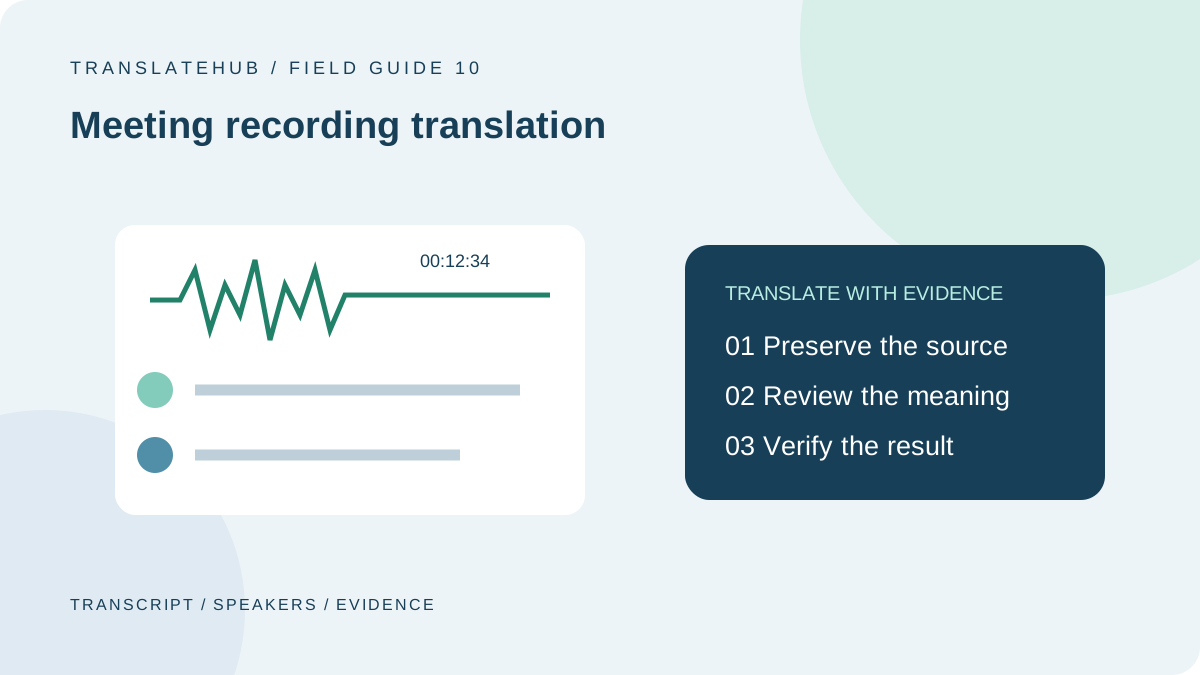
A segment record can contain a stable ID, start and end time, speaker label, source text, translation, and issue state. Timestamps help locate the source. Their precision depends on the actual tool and review; an automatically generated boundary is not necessarily an exact measurement.
| Field | Purpose |
|---|---|
segment_id | Stable reference across revisions |
start and end | Replay and navigation |
speaker | Confirmed or provisional attribution |
source and translation | Bilingual comparison |
issues | Audio, terminology, ownership, or date questions |
review_state | Draft, checked, or awaiting clarification |
Choose segment lengths that balance context and navigation. Very short units can separate a condition from its conclusion; very long units make errors hard to locate. Preserve neighboring relationships so reviewers can expand the context instead of evaluating isolated sentences.
6. Preserve the state of the discussion
Spoken language contains pauses, corrections, and unfinished thoughts. A readable translation may reduce irrelevant repetition when that editing scope is declared. It must preserve hesitation, conditions, and negatives that affect decisions. Label verbatim records and edited versions differently.
Consider the original statement “We could try the new process next week, if the tests pass.” It proposes a conditional trial. It does not establish that the team has decided to launch the process next week. A summary that removes could and if changes the discussion into an unauthorized commitment.
Expressions such as I will look into it, that should be possible, and let us confirm remain different from a completed decision. Positive or polite language is not proof of agreement. Translation should represent the meeting, not finish decisions the participants have not made.
7. Verify action items as a separate stage
An action item needs a task, owner, deadline or timing condition, status, and evidence location. Leave missing information blank or mark it for confirmation. Do not choose a participant or calendar date merely to produce a fully populated table.
Separate confirmed tasks, suggestions, open questions, and informational updates. Perhaps the design team could review this should remain a proposal unless someone actually accepts responsibility. Turning every discussed possibility into a task misrepresents the meeting.
Before distributing important minutes, ask the relevant owners to confirm assignments and dates. When they correct the record, preserve the revision and the original discussion location. Explain that the new information is a post-meeting clarification rather than silently rewriting what the recording contains.
8. Prioritize consequential words and quantities
Check negatives, percentages, magnitude, money, version numbers, dates, and proper names. Inspect the relationships around numbers as well: increased to and increased by mean different things. Matching the numeric tokens between source and translation does not establish equivalent meaning.
Relative dates such as next Friday or the end of the month need the meeting date and participants’ intended frame of reference. Do not automatically use the transcription server’s timezone or the editor’s current location. Preserve the original expression and request an explicit date when the reference remains unclear.
A second reviewer can independently replay important passages. If a sample reveals repeated recognition errors for a particular term, inspect the rest of the meeting for that pattern. Update the vocabulary or process rather than correcting only the first visible occurrence.
9. Deliver and revise the layers consistently
Distinguish the recording, source transcript, bilingual version, and minutes in the handoff. State the review coverage and unresolved questions. Permissions can differ between layers; every recipient of a short summary does not necessarily need access to the complete recording.
Retain stable segment IDs after revisions and record why a change occurred and which actions it affects. Correcting only the final summary leaves the underlying bilingual record stale, allowing the same error to reappear during later verification. Give the approved version an owner and a clear update date.
In an integrated system, treat speech recognition, text translation, and summarization as separate capabilities. Do not send audio files to an undocumented text-only endpoint. Follow the TranslateHub developer documentation for supported requests, while the application manages mapping, validation, and approval around the text translation stage.
10. Frequently asked questions
Can a recording go directly to translated minutes?
Some tools may produce an end-to-end result, but reviewable intermediate evidence remains important when accuracy and traceability matter. With only a summary, it is harder to determine whether an error came from hearing, translation, or summarization.
Can a speaker number become a person’s name automatically?
Not without reliable, authorized contextual confirmation. Numerical grouping identifies a voice cluster, not a verified identity. Keep provisional labels visible when the mapping is uncertain.
Are automatic timestamps precise enough for quotation?
Check the actual audio. Automatic boundaries can guide navigation but may need adjustment. Important quotations should retain the complete sentence and necessary surrounding context rather than relying on an unchecked timestamp alone.
How can the next meeting be processed better?
Improve recording conditions, maintain an approved glossary, and add observed errors to the post-editing checks. Fix recurring problems before spending effort on increasingly decorative summary formats.