How to build a translation glossary: terms, context and versioning
Build a maintainable glossary with concept definitions, approved terms, forbidden variants, language direction and release ownership.
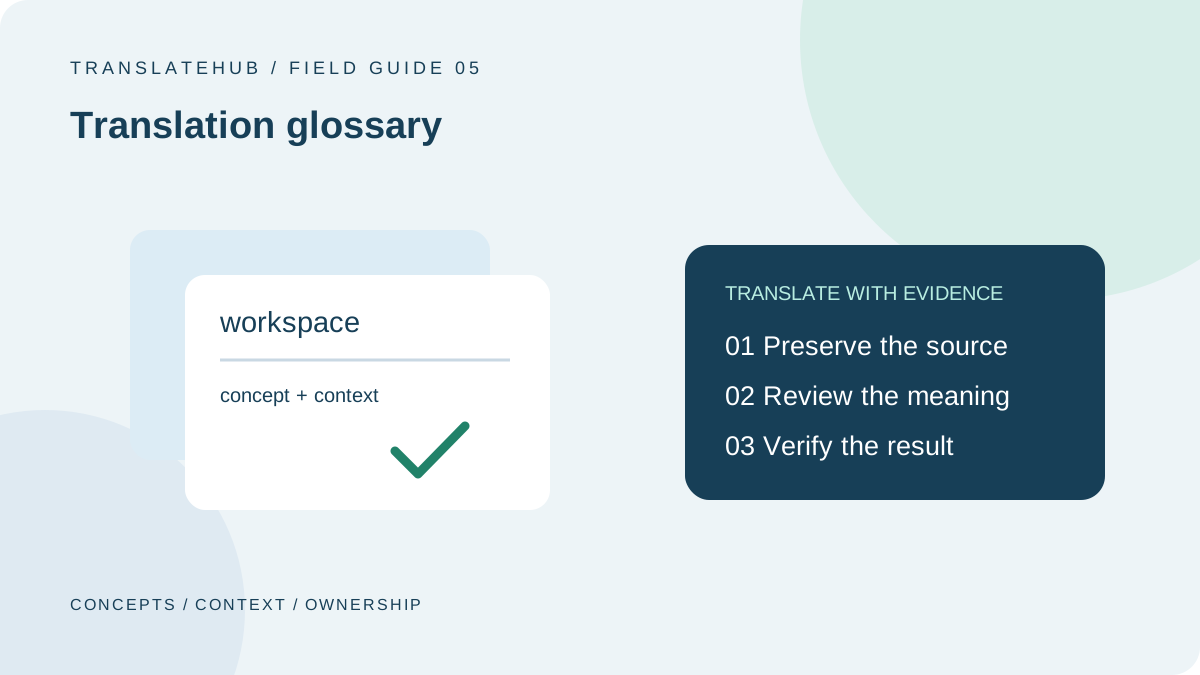
A product calls the same feature a workspace on its homepage, a project area in support articles, and a team space in customer replies. Each phrase sounds reasonable in isolation. Together, they make customers wonder whether the product contains three different features. A translation glossary is a practical way to prevent this confusion.
The useful question is not simply which word sounds best. A maintainable glossary explains what a concept means, where a term applies, and who can approve a change. This guide uses a fictional software product to show how to build that system. The record fields below are an internal design, not a claim that any particular translation API accepts them.
1. Start with a bounded user journey
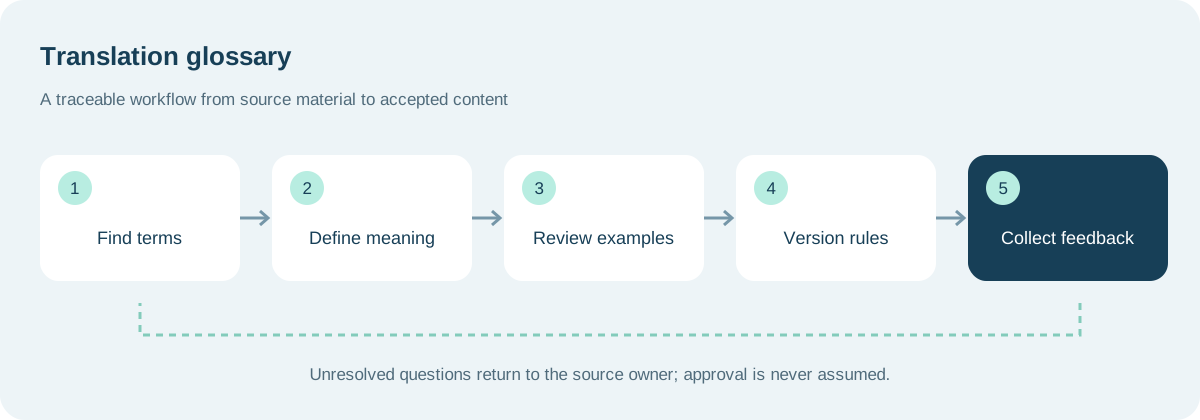
Choose a small, connected area such as registration, workspace creation, member invitations, and billing. Collect the interface strings, help articles, and support responses that describe that journey. Prioritize repeated names, ambiguous labels, and terms that affect what customers actually do.
Do not import a general dictionary and call the result a product glossary. Ordinary connecting words rarely need special governance. Complete approved paragraphs belong more naturally in a segment library, while one-off customer addresses should not become reusable terminology. Every additional rule creates a potential conflict that someone must maintain.
Keep a candidate list before approving translations. For each candidate, write down why it matters. This produces a more useful starting point than a large frequency list with no explanation. When the source terminology itself is inconsistent, resolve that problem before asking translators to preserve it.
2. Organize concepts, not just spellings
The English word charge can refer to a fee or to replenishing a battery. A universal rule mapping charge to a billing term will fail in a device manual. Give each concept a stable identifier and a domain, then attach the relevant source and target terms to that concept.
Likewise, account may describe a login identity or a financial record. Similar spelling does not prove identical meaning. Begin with a short definition, then select a target term that fits it. Definitions also make disagreements more productive: reviewers can discuss the concept instead of defending personal preferences.
Separate visible names from technical identifiers. A feature label can be localized without changing its API field, configuration key, or URL. Mark those identifiers as protected content. A terminology cleanup must not silently become a software migration.
3. Give each record enough context
| Field | Example | Purpose |
|---|---|---|
| Concept ID | workspace.container | Stable identity across renaming |
| Source term and language | workspace / en | Explicit translation direction |
| Target term and locale | 工作区 / zh-CN | Approved localized expression |
| Definition | A collaboration area containing members and resources | Meaning and scope |
| Usage | Creation dialog, invitations, help center | Context for decisions |
| Variants | Approved and forbidden alternatives | Review guidance |
| Status and owner | Approved; product content owner | Decision authority |
| Revision | terms-2026-10-a | Traceability and rollback |
Add part of speech, screenshots, capitalization, and examples when they resolve real ambiguity. A noun label and a verb instruction may require different treatment even when they share a stem. Avoid filling optional columns merely to make the spreadsheet look complete.
Maintain a rich master record and generate provider-specific exports from it. A service that accepts only two columns should not determine how much context your organization retains. Keep the export tied to its source revision so a later investigation can reconstruct the decision.
4. Review examples and counterexamples
Suppose workspace is approved as 工作区. Test the term in creation instructions, ownership labels, and leave-workspace warnings. The translation must work grammatically in each location. An isolated word pair can conceal awkward combinations or an incorrect interpretation of the product model.
Then test a sentence in which the same spelling has a different meaning. Include punctuation, capitalization, plural forms, and similar words. Short abbreviations deserve particular care because naive substring replacement may alter a larger word or a protected identifier.
Translation direction also matters. Reversing the columns of a glossary does not necessarily create a safe reverse-direction glossary. Several source terms may collapse into one target expression, losing a distinction that the reverse translation needs. Approve the intended directions explicitly.
5. Treat provider behavior as an integration detail
Matching behavior varies between services. For example, the Google Cloud glossary documentation describes case-sensitive matching by default and an option to ignore case. Do not assume another service follows the same rules.
Before integration, prepare a compact test set covering ordinary forms, capitalization changes, punctuation, related words, and out-of-domain uses. Save the input, expected result, and actual output. A request completing successfully does not establish that every terminology constraint was applied.
For TranslateHub, consult the API documentation for supported fields and capabilities. Your application can maintain glossary revisions and run checks around translation, but this architecture does not imply that an undocumented glossary parameter exists. Unsupported constraints should remain visible review requirements.
6. Define approval states and responsibilities
Use explicit states such as candidate, under review, approved, and deprecated. Translators can propose entries, product owners can confirm meaning, and target-language reviewers can judge expression. One person may hold several roles in a small team, but the reason for each change should still be recorded.
Distinguish factual corrections, official product renaming, and stylistic preferences. They have different migration consequences. A factual mistake may require immediate repair, while an optional wording preference may reasonably wait for the next content update.
Do not erase deprecated terminology without leaving a replacement and explanation. Historical records help reviewers understand old content and locate material that still needs migration. Deletion removes evidence; it does not solve the underlying inconsistency.
7. Migrate existing content deliberately
Before releasing a changed term, identify affected pages, help articles, message templates, and translation-memory entries. The candidate list should include the content revision, location, existing wording, and owner. Otherwise, a team may apply a valid correction to an obsolete export and overwrite newer work.
After replacement, inspect grammar, references, and layout. A longer feature name may overflow a button. A renamed entity may require changes to surrounding possessives or agreement. Treat migration as a content change rather than an unrestricted find-and-replace operation.
Keep the previous master glossary, provider export, and release record. Decide whether rollback must restore the terminology rule, the translated content, or both. Restoring the rule while continuing to serve translations cached under an old revision can produce a mixed release.
8. Measure applicable opportunities
The denominator for terminology compliance should be the places where a rule actually applies, not every word in the document. A page containing no relevant terms cannot demonstrate successful enforcement. Conversely, an allowed grammatical variation should not automatically count as a failure merely because it differs from the dictionary form.
Track false triggers, uncovered concepts, reviewer exceptions, and recurring disputes alongside compliance. When errors come from missing context, adding more synonyms may make the problem worse. When they come from stale assets, fix versioning and invalidation rather than changing the translation engine.
Review a few recent incidents from source copy through the final page. This separates unclear policy, failed execution, and legitimate linguistic judgment. Each failure type needs a different remedy and a different owner.
9. Prepare a release checklist
Every approved record should have a definition, language direction, scope, and accountable owner. Confirm that exports match the intended revision, technical identifiers remain unchanged, and both positive and negative tests exist. Make necessary exceptions explicit rather than hiding them in reviewer notes.
For cross-team work, define a dispute channel and a response owner. When a new term is unresolved, retaining the source term with a visible question can be safer than allowing several people to invent competing official names. The immediate goal is a consistent decision process, not a supposedly perfect dictionary.
10. Frequently asked questions
Is a larger glossary always better?
No. Prioritize concepts that affect understanding, navigation, or business consistency. Unused and poorly defined entries increase maintenance work and can trigger incorrect replacements. Review candidates periodically instead of promoting every extracted phrase.
Is a glossary the same as translation memory?
No. A glossary governs concept names; translation memory stores reusable source-and-target segments. They complement each other. See the translation asset comparison for a practical separation of responsibilities.
What happens when an engine has no glossary feature?
Provide approved context where supported, then check the resulting terminology and review exceptions. Do not manufacture consistency through unreviewed replacements that damage grammar or meaning. Application-side validation is still useful without native enforcement.
Should brand terms always remain untranslated?
Follow the brand policy and the intended market. Some names remain unchanged, while others have approved localized forms. Capitalization alone is not a reliable rule for deciding what must never be translated.
Combine your glossary with a post-editing workflow so terminology, meaning, and presentation are accepted together.