Translation memory vs glossary vs cache: what to reuse and when
Understand segment reuse, terminology rules and request caching, then design a reviewable workflow with provenance and context checks.
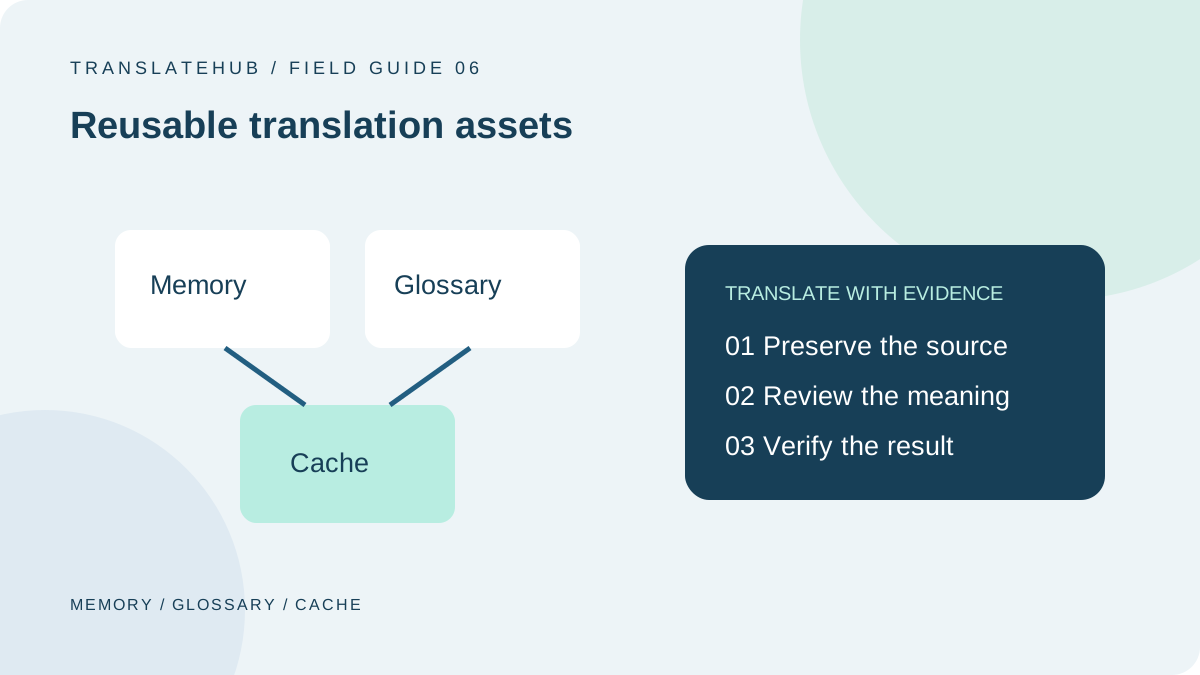
A sentence has been translated before. Can you reuse it immediately? That depends on what you found: an approved terminology rule, a reviewed bilingual segment, or the response to an old API request. All three can reduce repeated work, but they answer different questions and carry different evidence.
Confusing translation memory, glossaries, and caches can turn temporary machine output into permanent editorial policy. It can also make a high similarity score look like a quality guarantee. This guide separates the three assets and shows how to combine them without losing context, ownership, or review status.
1. Understand the three responsibilities
| Asset | Main content | Question answered | What it does not prove |
|---|---|---|---|
| Translation memory | Source segments and corresponding translations | How was similar material translated? | Suitability for the current context |
| Glossary | Concepts and approved names | What should this concept be called? | Correctness of the whole sentence |
| Request cache | Request conditions and previous responses | Has this computation already been performed? | Human approval of the response |
A memory unit may be a sentence or another clearly bounded segment. The European Commission’s DGT translation memory description explains paired source and target segments. Its legislative domain is also a reminder that a well-organized resource is not automatically suitable for every product.
A glossary generally contains smaller, concept-oriented decisions. A cache is primarily operational infrastructure. Label these sources clearly in the editing interface so reviewers can distinguish an approved asset from a temporary machine response.
2. Preserve provenance before optimizing reuse
A useful memory record includes source text, target text, language direction, domain, source revision, approval state, original location, and modification date. When a segment depends on context, keep its heading or interface location as well. Two strings and a similarity score are not enough evidence for responsible reuse.
Define what approved means. A spelling check is not a factual review, and a translation accepted for internal reading may not meet the standard for a public product page. Recording the acceptance level lets a later team decide whether an earlier result is suitable for its delivery requirements.
Before importing external assets, check usage conditions, provenance, and domain fit. Public availability does not remove licensing obligations or establish accuracy. Keep uncertain entries isolated until they have been evaluated rather than silently promoting them into a trusted production memory.
3. Exact text still needs context
The word Open may be a command on a button or a status on a support ticket. Free may describe a price or available capacity. An exact source match proves that the text is identical, not that the same target wording belongs in both locations.
Include locale, product area, and content type in reuse decisions. For consequential content, inspect neighboring sentences, numbers, and conditions. Moving a sentence from a descriptive paragraph into a confirmation dialog can change the clarity required even when the source text remains untouched.
Keep matched and approved-for-this-location as separate states. The first is a retrieval result; the second is a publishing decision. That distinction makes it possible to measure which segments were merely found and which actually passed acceptance.
4. Fuzzy scores are not accuracy percentages
Consider these original examples: “You may cancel before shipment” and “You may not cancel before shipment.” One additional word reverses the meaning. A candidate can be extremely similar at the character or word level while differing in the most important condition.
Highlight changes in negation, numbers, units, comparisons, and scope. Reviewers should resolve those differences before reusing the remaining sentence structure. Copying an old translation and changing only the obvious nouns can leave a serious factual contradiction behind.
Similarity calculations and contextual weighting differ between tools. Do not transfer a threshold from one system to another and assume the same risk. Use representative samples from your own content to decide which candidates can be prefilled and which require an explicit review step.
5. Make caches reflect the request contract
A cache avoids repeating equivalent computation. Its identity should therefore include the conditions that can materially affect the result: text, language direction, tenant, content type, terminology revision, relevant engine configuration, and any versioned context used by the request.
Do not automatically copy every cached response into an approved memory. Machine output can enter a review queue, but it becomes a trusted asset only after the required acceptance process. Conversely, a human correction should trigger a decision about invalidating old cached output so the correction is not overwritten later.
Cache expiration and content retirement are different events. An approved translation can remain valid after a cache entry disappears. A changed policy can make a translation obsolete before its cache expires. The translation caching guide discusses the engineering side of that separation.
6. Build an explainable combined workflow
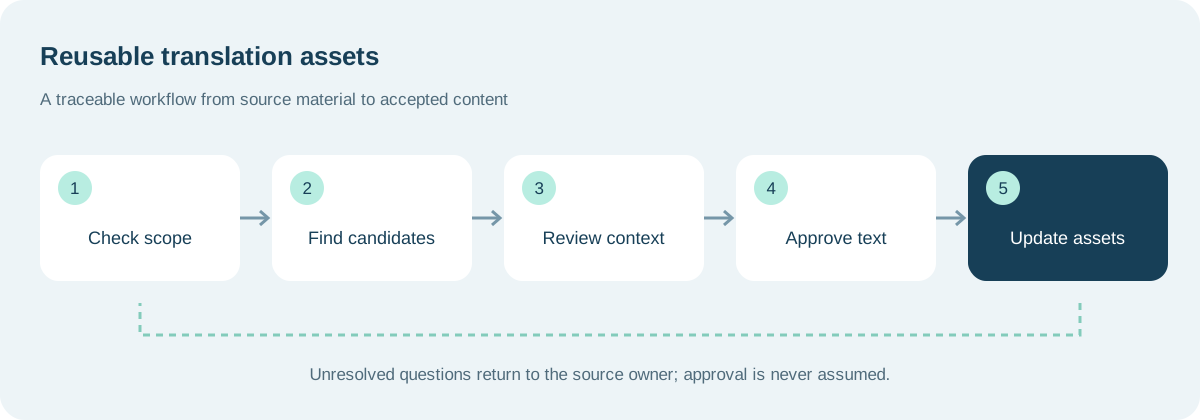
First establish the content’s access scope, language direction, and revision. Select applicable terminology rules, then retrieve memory candidates from the appropriate domain. Show their provenance and differences. Eligible matches may prefill an editor, but should retain an unresolved status until the applicable checks are complete.
When no suitable candidate exists, call an approved translation service and label the result as machine output. After review, save the accepted segment with its source revision and approval evidence. Update the cache used to serve the current content only after the relevant publication decision.
Each stage needs a recoverable state so an interrupted job does not make partial results look published. Consult the TranslateHub API documentation for actual request capabilities. This workflow is application-side asset management, not a claim that the API contains memory search, glossary approval, or quality scoring features.
7. Evaluate savings with a worked example
Imagine a help center with 1,000 pending segments. Of these, 300 have approved translations suitable for their current context, 200 have editable fuzzy candidates, and 500 require new translation. These figures are hypothetical and illustrate measurement; they are not industry averages.
It would be misleading to declare a 50% cost reduction from those counts alone. Segment lengths differ, fuzzy candidates take time to edit, and asset maintenance, formatting, and final acceptance still require work. Track reused segments, translated characters, editing minutes, and rework separately.
Compare total effort and defects under the same delivery standard. A workflow that reduces new translation volume but encourages misplaced trust in old wording may generate enough later corrections to erase its apparent benefit. Measure the completed task, not just the retrieval stage.
8. Test interchange rather than assuming it
TMX is commonly used to exchange translation memories, and the official DGT documentation describes its TMX resources. During migration, verify whether the receiving tool preserves the language tags, inline markup, context, approval status, and custom fields your process depends on.
Start with a small export containing difficult examples: line breaks, placeholders, formatting tags, and regional language variants. Import it into a test environment and compare source, target, and metadata. A successful import message does not establish semantic equivalence between the two systems.
Keep the original export and a field mapping. When the destination cannot preserve an important attribute, decide whether to keep an external association or prevent automatic reuse of affected entries. Dropping evidence while retaining the old trust level is not a safe migration strategy.
9. Govern scope, retirement, and conflicts
Customer-specific names, unreleased product details, and personal information should not enter a universal shared memory merely to improve hit rates. Establish sharing boundaries before configuring retrieval. Use authorized material or fictional examples for testing.
Support retirement and reverse lookup. When a promise is withdrawn or a translation corrected, identify the published pages that reused the affected entry. Editing the memory alone does not repair copies already embedded in documents, websites, or application bundles.
Periodically inspect duplicates, conflicting translations, and ownerless entries. Resolve conflicts against current product facts and approved terminology, not simply the most recently imported version. Frequency is useful evidence of use, but it is not proof that a translation is correct.
10. Frequently asked questions
Does a small team need three separate systems?
Not necessarily. Begin with reviewed bilingual segments and a concise glossary. Add caching when repeated request costs or latency justify it. Clear responsibilities matter more than adopting several tools before the content workflow is understood.
Can exact matches publish automatically?
Only under a policy that explicitly permits it and verifies context, version, and risk. Important commitments and sensitive operational instructions may still require human confirmation. String equality alone is not an adequate release criterion.
Can translation memory replace translation?
No. New concepts, changed contexts, and unseen segments still require translation and review. Memory reduces repeated work; it does not create correct answers for all future content or resolve ambiguities that were never recorded.
Should terminology or memory come first?
Start with the current source of waste. Inconsistent names call for glossary management. Repeated paragraphs justify reviewed memory. Both benefit from explicit post-editing criteria that define when reuse is acceptable.