Business email translation: subject lines, tone and reliable replies
Translate business email without changing commitments, dates or amounts; use bilingual examples, thread context and a pre-send review.
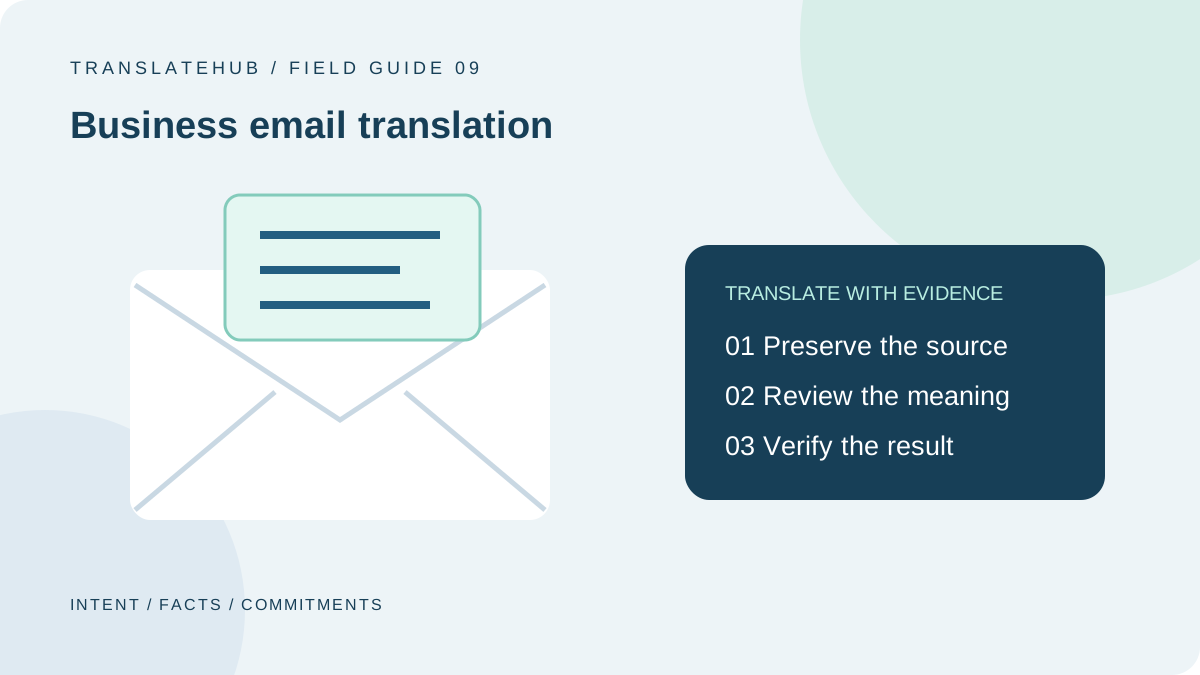
The most consequential errors in business email translation are often not difficult vocabulary. They are changes in intent: a question becomes confirmation, an evaluation becomes a commitment, or an old quotation is treated as the current offer. A fluent translation can still move a conversation in the wrong direction.
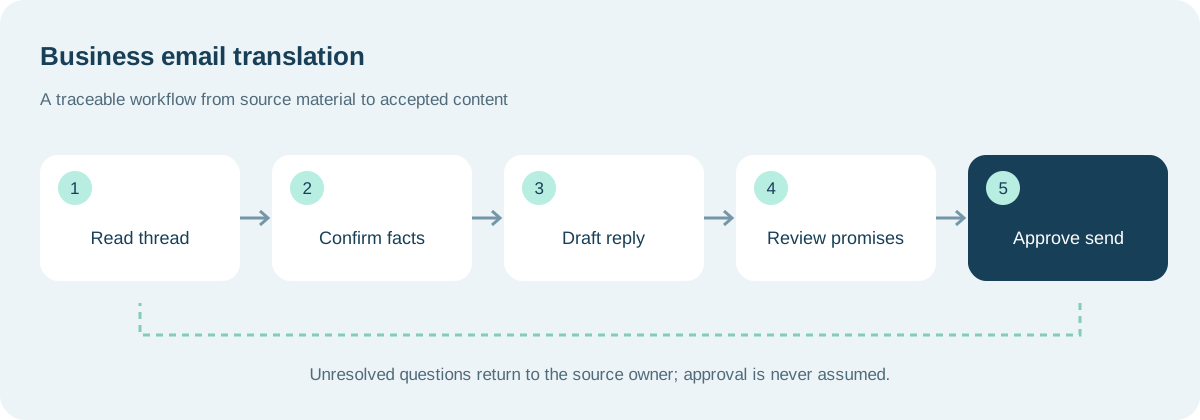
A reliable workflow separates understanding the incoming message, establishing the facts, drafting a response, and approving the send. This guide provides bilingual examples and a practical review method for everyday business communication. All scenarios and project names are illustrative; replace them with verified information before use.
1. Read the thread, not only the final sentence
Identify the latest message, quoted history, and attachment references. Phrases such as this version, the date above, and as previously agreed depend on earlier context. Translating only the last paragraph may accidentally revive a plan that a later message already withdrew.
Create a compact fact card: the current question, confirmed facts, unresolved points, latest attachment, response owner, and requested reply timing. This card is the basis for drafting, not an outline that a translation tool may freely complete with assumptions.
In forwarded conversations, retain who said what. A supplier’s suggestion must not become your organization’s approved decision. Preserving the necessary speaker and time relationships helps keep responsibility and status intact across languages.
2. Separate incoming comprehension from outgoing drafting
An incoming translation should preserve the sender’s questions, conditions, and uncertainty. An outgoing reply first requires a decision about what your organization actually intends to say. Translate the approved draft rather than treating translate and reply as an unreviewed black box.
For example, “Could you confirm whether the sample is ready?” requests information. It does not announce that the sample is ready. A response thanking the sender for confirming completion would introduce a fact that the original message never established.
Built-in email translation can assist reading. Microsoft’s Outlook translation guidance describes message translation and returning to the original, with details varying by version. A translated view is a reading aid, not business authorization to accept the message’s terms.
3. Preserve the communication act
| Intended act | Example wording | Boundary to retain |
|---|---|---|
| Request information | Could you confirm…? | Not yet confirmed |
| Make a suggestion | We suggest reviewing… | Not a mandatory decision |
| Describe a possibility | We may be able to… | Not a guarantee |
| State a plan | We plan to… | May depend on conditions |
| Confirm a fact | We confirm that… | Requires verification |
Politeness does not require vagueness. State a clear request and provide relevant context instead of adding several layers of indirect phrasing. Conversely, a concise source-language reminder should not automatically become an accusatory or threatening target-language message.
Adjust tone to the relationship. Please review may be entirely natural between colleagues, while a first contact may need an explanation of the purpose. One fixed business-English template cannot represent every recipient, hierarchy, and situation accurately.
4. Make the subject line actionable
A useful subject can combine the project, matter, and required action: “Project Atlas — confirmation needed for revised delivery date.” It tells the recipient what needs attention instead of relying on vague labels such as Important or Follow-up.
Do not increase urgency while translating. Final notice and immediate response required should appear only when the sender actually intends and authorizes them. If a thread’s subject no longer matches the discussion, changing it is an editorial decision for the sender rather than an automatic translation step.
Open with the purpose, provide the necessary facts, and finish with the request or next step. Short paragraphs and explicit references usually travel better across languages than long ceremonial introductions. Brevity must not remove conditions or responsibility boundaries.
5. Template: request clarification without guessing
In this fictional scenario, a counterpart mentions delivery next week without specifying the deliverable or date.
中文:感谢更新。为便于安排内部审核,请确认“下周交付”指的是完整报告还是初稿,并提供预计发送日期及所用时区。收到确认后,我们会更新审核安排。
English: Thank you for the update. To help us schedule the internal review, could you confirm whether next week’s delivery refers to the complete report or a draft? Please also share the expected sending date and the timezone used. We will update the review schedule once these details are confirmed.
The example does not invent a calendar date or promise that the review will finish at a particular time. It turns an ambiguous statement into two answerable questions. The final sentence describes a next step that remains conditional on receiving clarification.
6. Template: communicate delay and conditions
中文:目前还有两项测试未完成,因此我们尚不能确认最终交付日期。我们计划在完成测试后提供更新。如需先审核已完成部分,请告知,我们会确认可提供的范围。
English: Two tests are still outstanding, so we cannot yet confirm the final delivery date. We plan to provide an update after the tests are complete. If you need to review the completed sections first, please let us know, and we will confirm what can be shared.
This draft preserves the incomplete status and leaves the shareable scope subject to confirmation. Do not replace it with a firm delivery promise merely to sound positive. Do not invent supplier failures or other explanations that the sender has not verified.
A template organizes expression; it does not validate the facts. Before sending, confirm that the number of tests, their status, and the permission to share partial work match the actual situation.
7. Template: acknowledge receipt without accepting terms
中文:我们已收到修订后的方案,将按内部流程进行评审。此邮件仅确认收到文件,不代表已接受其中的价格或交付条件。评审完成后,我们会另行回复。
English: We have received the revised proposal and will review it through our internal process. This message confirms receipt only; it does not confirm acceptance of the pricing or delivery terms. We will respond separately after the review.
This example illustrates a linguistic distinction, not a legal conclusion about a particular transaction. Important commercial terms require review by an authorized owner. Received, understood, accepted, and approved should not collapse into one generic confirmation expression.
A team template library can document when each of those verbs is appropriate. That makes a copied response a prompt to verify the business state rather than a convenient way to skip the decision.
8. Verify dates, amounts, and attachments
Avoid ambiguous all-numeric dates where readers may interpret the order differently. Spell out the month or use a clearly agreed format, and specify the timezone when it matters. Translating into another language must not silently change the original date or deadline window.
Check currency, quantity, units, and any explicitly stated inclusions. When the source does not say whether a charge is included, flag the missing information rather than completing it from habit. Company names, order identifiers, email addresses, and filenames generally need exact reference checking.
Verify attachments in the real sending environment. Please find attached does not establish that a file is attached, and the correct filename does not prove it is the correct revision. Check the file itself or its version identifier so an internal review draft is not sent as the approved deliverable.
9. Build a controlled bilingual reply workflow
Submit only the material required for translation. Remove irrelevant signatures, contact details, and old conversation history when appropriate. A simple request should not automatically carry the project’s entire sensitive record into another service. Confirm the tool’s processing scope instead of treating all online translation methods as equivalent.
Show source, target, and open questions side by side. Highlight commitment words, numbers, dates, and attachment references. For important messages, obtain content approval from the responsible business owner, then let the sender check recipients, copied parties, and the final version.
Maintain template scope and revision history. Remove obsolete product names, policies, and contacts. Use a glossary for consistent terminology and consult the API documentation when integrating translation. A successful response must not automatically authorize sending an email.
10. Frequently asked questions
Should business email always sound highly formal?
No. Aim for clarity, appropriate courtesy, and fidelity to the relationship. Excessive formality can hide the request, while unnecessary force can change its meaning. Preserve facts and actions before adjusting politeness.
Can machine translation be sent directly to a customer?
Tools can produce useful drafts, but facts, tone, and commitments still need checking. Messages involving prices, deadlines, or important conditions should be approved by someone authorized to make those statements.
Must English follow the Chinese sentence order?
No. Sentences may be split or reordered for readability, provided that information, conditions, and responsibility remain equivalent. Structural adaptation is not permission to add or omit business meaning.
How can teams reduce repeated review?
Maintain approved scenario templates and protect variable fields. Review them when business facts change. The asset reuse guide and post-editing workflow explain how to reuse language without treating old approval as permanent validity.