EPUB ebook translation: chapters, navigation, notes and reading order
A structured EPUB translation workflow covering chapter identity, navigation links, footnotes, language metadata and reader testing.
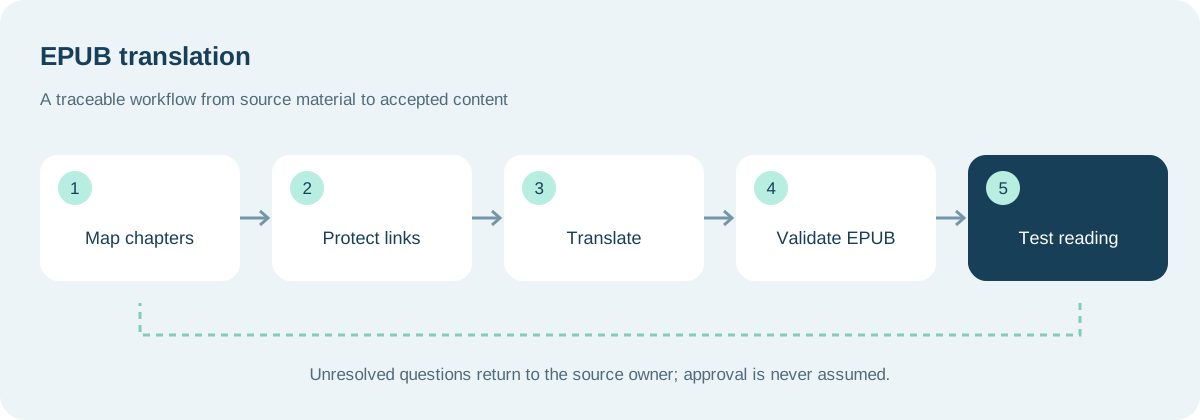
Translating an EPUB is not simply replacing one long text file with another language. Readers still need to navigate from the contents to a chapter, follow a note and return, change text size and understand illustrations. Fluent prose inside a broken publication is not a finished ebook.
This guide is intended for files you are authorized to process and content you control. Confirm the permitted translation and distribution scope first. For protected material, use an authorized source or the publisher’s supported process; a normal translation workflow does not require bypassing protection.
1. Understand the publication’s resources and structure
The W3C EPUB overview describes how content resources and a package document organize a publication, including metadata and reading order. Translation therefore involves navigation, styles, images and language information as well as visible prose.
Do not guess chapter sequence from alphabetical file names or concatenate all extracted paragraphs into one enormous string. Create a readable inventory of resource paths, chapter titles, reading positions, translatable objects and protected objects. This inventory becomes the shared reference for translation, review and reinsertion.
Record objects that cannot be handled automatically rather than silently excluding them. A complete inventory can reveal that a supposedly straightforward book contains image-based instructions, embedded examples or a complex index requiring separate editorial work.
2. Distinguish reflowable content from fixed-layout needs
Reflowable prose needs to remain usable at different text sizes and window widths. Content designed around a fixed page needs closer visual inspection. Agree on whether the translation may recompose pages, alter text inside illustrations or add explanatory material before starting.
For illustrated textbooks, diagram-heavy guides or complex tables, pilot a representative chapter. Avoid promising universal one-click fidelity. A file opening successfully does not establish that every type of content has been extracted, translated and recombined correctly.
The intended distribution environment matters too. Identify the reading systems you need to support and the features that are essential for this publication. That scope gives testing a concrete target instead of an unbounded promise to work identically everywhere.
3. Preserve stable chapter and passage identities
Connect source and target with resource paths and content identifiers. A visible title can change language without requiring its file path or anchor to change. Renaming internal resources just to make them look localized introduces additional references that must be updated and tested.
For example, a passage in chapter-03.xhtml may link to a note identified as note-7. The translated wording may change, but the relationship should survive. Stable identities also make later author revisions manageable: changed passages can be reviewed without retranslating the entire book.
When a structural change is genuinely necessary, treat it as an explicit migration. Keep a mapping from old references to new ones and test inbound as well as outbound links. A local edit can affect a reference located several chapters away.
4. Translate text while protecting markup
Separate ordinary text from code samples, URLs, resource paths and identifiers. Prose and meaningful image descriptions usually need translation; code and addresses follow explicit project rules. Avoid unrestricted search-and-replace across package resources, because the same string can appear in unrelated structural contexts.
Preserve the meaning of emphasis, quotations, lists and inline links. A target language may require an inline marker to move with the phrase it describes, but the result must remain structurally valid. Send unsupported mixed-content cases to controlled manual handling instead of dropping their markup and declaring success.
Treat a missing marker as a review problem, not merely a cosmetic defect. A link or note can carry evidence essential to the sentence. Removing it changes what the reader can verify even when the visible text still reads smoothly.
5. Validate navigation and notes as round trips
Translate the contents labels while retaining correct destinations. When a chapter title changes, compare it with the navigation label. For notes, test both the path from the main text and any return path to the original reference.
A link checklist can include source resource, target resource, fragment identifier, purpose and result. Distinguish a missing file, a missing fragment and a link that reaches the wrong chapter. Merely finding a matching URL string is not enough to prove the reader arrives where the text promises.
| Reading object | Relationship to verify |
|---|---|
| Contents entry | Label matches the destination chapter |
| Cross-reference | Destination matches the described subject |
| Note | Text-to-note and note-to-text navigation |
| Illustration | Caption and image remain associated |
| Index entry | Destination actually discusses the topic |
6. Review publication metadata and image descriptions
For a target-language edition, agree on the treatment of the title, description, author display and language information. The W3C EPUB 3.3 specification defines publication structures and metadata. Modify fields according to their purpose, not by translating everything that resembles human-readable text.
Include meaningful image text and alternative descriptions in scope. A description should explain the image’s role in the surrounding passage rather than repeat the whole paragraph or accumulate search keywords. Follow editorial rules for brands, names and bibliographic references, and retain the evidence used to resolve uncertain proper names.
7. Establish terminology and narrative style early
Book-length consistency involves more than individual sentence accuracy. Names, specialist vocabulary and narrative voice need coherent treatment. Create a short style brief covering person, preferred register, proper-name handling and chapter-title conventions, then maintain an approved glossary.
Do not promote an unreviewed machine translation from the first chapter into a mandatory rule for the whole book. Test choices in representative passages before applying them broadly. When one source term has different meanings in different chapters, preserve those distinctions rather than imposing superficial uniformity.
A useful style brief also records what not to normalize. An author’s deliberate distinction between a tentative hypothesis and an established conclusion should survive even when an editor prefers smoother prose. Consistency should clarify meaning, not flatten meaningful variation.
8. Work in manageable units without losing context
Choose units that balance context and traceability. Very small fragments can lose pronoun references or the logic of an argument. Very large requests make omissions and retries harder to locate. Chapters or coherent subsections can work well when supplemented with necessary neighboring context.
Record the source revision, terminology revision, processing state and reviewer for each unit. Distinguish new content, changed content and layout-only corrections. At the next release, those records show which passages need linguistic review and which changes affect only resource structure.
9. Combine conformance checks with real reading tests
W3C’s EPUBCheck evaluates publications against EPUB format requirements. That is important, but it does not establish translation accuracy, coherent chapter logic or a satisfying reading experience. A structurally valid publication can still contain a serious mistranslation.
Test navigation, notes, search, text resizing and image display in the reading systems within scope. Pay special attention to long headings, long links, nested lists and tables. When behavior differs, record the reader, settings and exact location rather than filing a vague report that the mobile version looks wrong.
Include at least one continuous reading session, not only isolated spot checks. Reading a chapter in sequence can reveal inconsistent names, lost transitions and repeated content that a file-level validator has no reason to flag.
10. Deliver provenance and an update trail
Retain the original, resource inventory, bilingual review record, final EPUB and known-issues statement. Validate again after corrections and describe what changed. File names can identify language and revision, while internal publication identifiers should follow the publisher’s management rules.
For API integration, send supported text to the translation service and keep resource parsing, identifier protection and packaging in the application. This guide does not imply whole-book upload or automated publishing capabilities in TranslateHub. Confirm the supported request types in the API documentation.
Frequently asked questions
Can I translate an EPUB as ordinary text?
Text extraction can help with understanding or drafting. Delivering a usable EPUB additionally requires its structure, navigation and resources. A translated text dump does not demonstrate publication completeness.
Should chapter file names be translated?
Usually they do not need to be. Reader-facing titles can be localized while internal paths remain stable. When paths change, update and test every affected reference.
Why are there problems after format validation passes?
A validator checks format requirements, not faithful meaning or every reader’s visual behavior. Linguistic review and actual reading tests remain necessary.
Can a glossary guarantee consistency across the whole book?
It helps constrain key concepts but cannot replace context and editorial judgment. Combine the glossary guide with the translation-memory workflow for controlled reuse.
The completion standard is a publication that readers can understand, navigate, verify and continue reading—not simply a package containing another language.